Showing posts with label books. Show all posts

Friday, 12 January 2018

Marvellous Museums


If like me and my children, you love going to museums, you're bound to have a favourite. For me it's Bowes Museum near Barnard Castle: http://thebowesmuseum.org.uk/ ,because it has such a brilliant variety of treasures from the past; everything thing from a silver swan automaton which preens itself every hour, to incredible dresses and rare works of art. My eldest daughter's favourite is The Natural History Museum: http://www.nhm.ac.uk/She will go back to it time and again and I'm sure it is because we visited when she was young and she fell in the love with it. At the time she was obsessed with dinosaurs and enjoyed putting her large collection of plastic dinosaurs on display at home. 


Which leads me on to making museums at home.
Most children love collecting and sorting, which makes creating a home-based museum a very engaging activity. These items can be anything: toy cars, shells, Lego models, anything that interests your child. Your museum could be as small as you want; just the top of a book case for an Autumn museum for example, with a temporary display of Autumn finds. 


A historically themed mini-museum, such as the Ancient Egyptians could lead to making models and artefacts.
You could begin with a visit to a local museum and discuss what is there, how it is set out, what they enjoyed finding out about. Then all you really need to make a museum at home is paper, cards and pens and a collection of items, or artefacts!
Start with deciding how to display the items; perhaps in boxes with cut outs to look into or on some shelf space that has been cleared.

Now for exhibition labels, perhaps on small folded cards, describing what the artefacts are. This is a good way to support some research, as well as practising factual writing. Encourage your child to to be precise, including the name, dates and other relevant information, rather than opinions, such as “This is the best dinosaur.”

 For example:

Tyrannosaurus Rex
T-Rex was a carnivorous dinosaur which lived in western North America
 68 to 66 million years ago.
It weighed up to 14 tons and was 12 metres long.
Fascinating fact: Tyrannosaurus Rex had the strongest bite of any animal ever discovered.

Another writing route is to create a leaflet all about their museum. Discuss what they'd need to include:  a brief description of the museum, opening times, facilities, location and so on. Leaflets are a great way to encourage paragraph writing, sub-headings and captions. A map could be included on the back. Using ICT can lead to colourful and professional looking leaflets.


Finally, your child might also like to take on the role of a museum guide, showing visitors around the exhibits and telling exciting stories about where the artefacts were found.
So as the nights draw in and the weather keeps us indoors, fashioning a museum out of treasured possessions can be a lovely way to spend a wet day. If making a museum seems a bit daunting however, you could always help your child turn their books into a library. We still have a few of the books from my husband's library he created when he was nine, all catalogued and with pockets for the lending tickets! See my previous post 'Making Books'
https://blackheneducation.blogspot.co.uk/2017/02/

Whatever your child's interests, I hope you have lots of fun creating your mini-museums. We would love to see photos of your finished museums at Blackhen too!
This post was written by Bernadette Whiteley, a KS2 & KS3 English tutor at Blackhen Education.

Thursday, 19 February 2015

'Witch Child' - KS3 (12-13yrs) English course.


This month our 12-13 year old students have been working on a unit of work based on the book 'Witch Child' by Celia Rees. It tells the story of the world of Mary Newbury, whose grandmother is accused and murdered for being a witch. Her story is told in the style of a diary.


One of the tasks was to create a poster, warning people in 17th century England of witches. The students came up with some wonderful ideas and here are a few of their designs.


 Angus's poster.


Elena's poster.


Jake's poster.

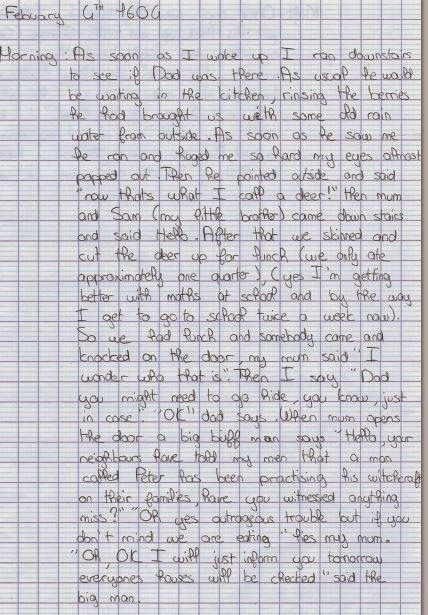
For another lesson they had to write a diary entry, as if they were someone or knew someone who had been accused of witchcraft.

 Angus's diary entry.


Jake's diary entry.


Elena's diary entry.

Tuesday, 27 January 2015

Blackhen Education's Top 5 Children's books about the Holocaust


January 27th marks Holocaust Memorial Day. On this day we remember the millions of Jews that were murdered in the concentration camps by the Nazis during World War II. It is very important that each generation of children learn about the Holocaust and the atrocities that occurred.

At Blackhen Education we believe that one of the best ways for a child to learn about the Holocaust is through reading about the subject, whether it be autobiographical books (Anne Frank's Diary) or fiction (The Book Thief).

There are lots of resources to help children research this subject; be it books, films, online, documentaries etc. Due to the nature of this topic, parents do need to exercise some discretion and guidance for their children when finding out about this shocking episode in history. We would probably suggest that 13 years plus is probably the best age for children to first approach this subject. This is in line with most schools in the UK. 

We have complied a list of 5 books for teenagers and young adults to learn about the Holocaust and the issues raised by it.


.
Number the Stars - Lois Lowry

'It is 1943 and for ten-year-old Annemarie Johansen life in Copenhagen is a complicated mix of home and school life, food shortages and the constant presence of Nazi soldiers. She knows about bravery from the stories of the dragon-slaying knights that she reads to her younger sister. But Anniemarie's best frien Ellen is a Jew. As the German troops begin their campaign to eradicate all the Jews of Denmark, Annemarie is called upon for courage and a very real-life feat of bravery'. Amazon books.

Milkweed - Jerry Spinelli.

'The book is about a boy in Warsaw, Poland in the years of World War II during the Holocaust. Over time he is taken in by a Jewish group of orphans and he must avoid the German troops (or "Jackboots") while living on the streets with other orphans'. Wikipedia

The Holocaust - Susanna Davidson

'Under the cover of the Second World War, the Nazis set out to kill every Jewish person in Europe, in what is now known as the Holocaust. This book looks at the events leading up to it and describes what happened, using historical fact and survivors' stories to give a moving and sensitive account'. - Google books.

The Earth is Singing - Vanessa Curtis

My name is Hanna Michelson. I am fifteen. I am Latvian. I live with my mother and grandmother. My father is missing - taken by the Russians. I have a boyfriend. When he holds my hand,everything feels perfect. I'm training to be a dancer. But none of that matters now. Because the Nazi have arrived and I am a Jew. And as far as they are concerned, that is all that matters.
This is my story' - Usbourne books
The Boy in the Striped Pyjamas - John Boyne

'This book follows a 9-year-old boy named Bruno growing up during World War II in Berlin, Germany. He lives in a huge house with his parents, his 12-year-old sister Gretel and servants, one of whom is called Maria. After a visit by Adolf Hitler and Eva Braun, Bruno's father is promoted to Commandant, and the family has to move to "Out-With" because of the orders of "The Fury".- Wikipedia


Details of all our English courses can be found on our website: www.blackheneducation.com or contact us at: sue@blackheneducation.com

Thursday, 8 January 2015

6 ways to read your way to a healthier 2015!


January is here again!
Once again we will all be looking to become better people. Be it slimmer, smoke-free, alcohol refraining, multi-lingual, kinder or less-stressed. The list goes on. For many, these admirable aims will fall by the way side within a few weeks. However, one area you can succeed in, and improve your life immeasurably is by making a list of literary resolutions. You may not have a slimmer waist line nor win the Nobel Peace Prize, but these are resolutions that you can keep. And they’re fun!
                                                            

Read More
For many, life seems to get in the way of a good book. However, they are a great way to unwind and escape the pressures of the day. Try to read at least 30 minutes a day. Why not switch off the TV or computer and grab a book (or tablet) before going to sleep? In addition, you might want to set yourself a goal to read a book a month, or two, or more? Why not draw up a list of books that you feel you should read? Or just ones that interest you?
Read New
Whilst buying a second hand book is a cheap way to stay well-stocked with reading material, it doesn’t help the author. They only receive payment once. Why not buy a new book for every three second-hand books you read.


Read Debut
Change can be a frightening thing. However, it can also reap rich rewards. Every now and then why not plunge into the sea of new writers out there. If you have a favourite writer, investigate who they like and recommend. Established writers often champion those new in print. Find out who they recommend.
Read Local
For many would-be book buyers the first thing they will do is type ‘Amazon’ on their keyboard. However, why not wander down to your local bookshop (or even find out where it is). Many local bookshops are fighting a losing battle at the moment to online retailers. Where you spend your money is a personal choice and deciding to help a local business, especially an independent  bookshop, can mean the difference between them staying afloat or disappearing to the stockroom in the sky.
Read Different
Even if you love sports autobiographies or gritty crime novels, why not break out into a different genre? If you have a subject that has always interested you but you’ve never got round to reading about it, do it this year! Or maybe something you’ve just heard about or read and want to know more. Go on, pick up that book and read it.


Read and Recommend
If you’ve read a great book, don’t keep it to yourself. Let friends and family know about it. Why not donate the books you’ve enjoyed reading to a charity and slip a note into each one saying how great it is? This way, the author’s work gets passed along and you’ve helped out a good cause. Plus you’ll have book space for all of your new purchases for 2015.

Finally remember that sometimes the fun things in life can get forgotten about in the mad rush of family life and work. Even if you only do one of the above, you will have a great 2015. 


This post was written by Andy Mackay ( KS3 & IGCSE Tutor at Blackhen Education).

Contact us at: sue@blackheneducation.com for one of our recommended reading lists for children.

www.blackheneducation.com 


Monday, 8 December 2014

Blackhen's Top Ten Books for Christmas


Christmas is a lovely time to give books and receive them. It is a great way of encouraging children to read and to feed their imagination. This year there are dozens to choose from, whether you buy them online or from a bookshop. Whether you want a pop-up book, noisy book, book without pictures or sticker book.

I still think some of the best are those I loved as a child or as a mother, reading to my two children. They are imprinted on my mind and still hold a special place for me.
We have had a good perusal of books on offer for children this Christmas and have come up with our list of ten books. Some of them are classics and a few are not so well known.


‘The First Christmas’ – Jan Pienkowski
I love this very traditional book about the Nativity story, because of the wonderful silhouette illustrations.

‘Father Christmas’ – Raymond Biggs
This book still makes me smile and we use the film version of the story in our English course for 6-7 year olds. The book tells the story of a grumpy, miserable Father Xmas, who is fed up with his job.

‘The Jolly Christmas Postman’ – Allan and Janet Ahlberg
This is a wonderful book for young readers. The book includes real letters that children can take out of the envelopes to read. A delightful book for Christmas.


'Jacqueline Wilson Christmas Cracker' - Jacqueline Wilson
Jam - packed with Jacqueline Wilson goodies! There are festive puzzles, tasty Christmas recipes, perfect present tips and fun Christmas facts. 
'The Best Christmas Present in the World' - Michael Morpurgo
A haunting story from one of our best loved children's writers. A very appropriate story for 2014, the year of the Centenary of WW1.

'Odd Socks Learns All About Christmas' - Melinda
Odd is hoping for a present from Santa. But does Santa ever give presents to cuddly toys?

The Most Beautiful Christmas Story Ever ' - Adina Pasa
Adina is not having good Christmas. A boy at school keeps telling her that Santa doesn't exist.


'Dear Santa' - Rod Campbell
A wonderful book for very young children. Lift the flap on every page and find the present!

‘The Night Before Christmas’ – Clement C. Moore     
The much loved classic Christmas poem is brought to life in this gorgeous picture book. A beautiful present for any child.

'Father Christmas Needs a Wee' - Nicholas Allan
Father Christmas has been drinking drinks since half past three.... Find out what happens in this brilliant and funny counting book.


Wednesday, 3 December 2014

Key Stage 3 - Gothic Literature


One of the units for our 12-13 year old students is 'Gothic'.

Most of our older students have heard of 'Dracula' and 'Frankenstein, but have not studied the texts or genre of Gothic literature in their French schools. They only know of the characters from films and comics.

In the unit of four lessons, they look at:

1) The Gothic genre
2) Research Dracula or Frankenstein
3) Design a book cover for a Gothic novel
4) Write an interview with a character from a Gothic novel

We believe it is important to have a mixture of written and creative tasks in the units for all of our students. Here are some of the wonderful book cover designs we received this year.


I am always impressed with the imaginative and creative designs they come up with!


 I love the 'foggy' atmosphere that this student has been able to achieve with her front cover for Dracula. I also like the choice of font for the description for the book.


This poster is brilliant! It was all hand drawn by Dan and is really quite creepy when you see it in the flesh!

Wednesday, 4 June 2014

To Kill or not to Kill a Mockingbird?


In the last ten days two stories have loomed large in the world of Literature. One was the announcement that two titans from the world of 20th century Literature, namely ‘Of Mice and Men’ and ‘To Kill a Mockingbird’, were amongst a number of texts to be dropped from the English Literature syllabus of several exam boards in the UK. The other was the death of writer and Civil Rights campaigner, Maya Angelou. The two events were met with many column inches, both in the press and on the Net. However, the responses were very different. The former story garnered a general intake of breath and then an angry outcry from many. The latter produced an outpouring of sadness and a sense that one of America’s great voices in Literature, had passed.

The decision to drop a range of American literary texts was apparently at the behest of the current British Secretary of State for Education, Michael Gove. The head of the OCR examining board’s review committee Paul Dodd, said that Mr. Gove wished that schools in England should concentrate on British literature from now on. In addition, it was reported that he had a particular dislike for ‘Of Mice & Men’ and was concerned that so many British school children studied it (close to 90% according to recent figures). So is this the end for Lennie, George, Atticus and Boo?


Is there time to teach ‘additional texts?’


Mr. Gove has now hit back against his critics, claiming that he hasn’t requested they be dropped nor in fact hates Steinbeck’s book. What ever the real truth is, the new reading lists for the British exam boards of OCR, AQA and EDUQAS (formerly WJEC) do not list Steinbeck, Lee or in fact any American writers. The Secretary of State for Education has stated in an open letter to the British newspaper ‘The Telegraph’ that ‘schools are free to teach these texts in addition to the proscribed ones’. However, with time being a major factor for English teachers, it is highly unlikely that most schools will find neither the time nor the inclination to do so. Schools these days live or die by their exam results, so quite simply if children are not going to be examined on a text, they won’t study it. Results are the name of the game in the UK classroom of 2014.


                           Why should children study these books?

From my personal experience both ‘Of Mice and Men’ and ‘To Kill a Mockingbird’ pack a punch. In Steinbeck’s story, we see the bleak and at times brutal world of rural America during the Great Depression. Though a short text, with only six chapters, it manages to both tell an engaging tale but also to deal with a number of important themes. These range from the casual racism of the farm workers directed towards the long suffering black stable hand Crooks, to the fear that any of the men could lose their job if they incur the wrath of their boss or his arrogant, bully of a son.

Kids enjoy this story!

This text is taught in so many schools for good reason. It is quite simply a brilliant story that in my experience has never failed to interest and usually entrance, the students who are reading it. From the first pages where there is open mockery of the hapless and slow-witted Lennie, to the final page, where on more than one occasion, a student has burst in to tears at the powerful and dramatic dénouement. Kids enjoy this story! What’s more they care about the characters and the issues raised. As a teacher I can only echo the remarks of many in the press and on the Net last week, that regardless of ability this is a story that engages students. It may not be George Elliot’s ‘Middle March’ or Jane Austin’s ‘Pride and Prejudice’ (two favourites of Mr. Gove apparently), but for a 15 year old at an inner city school, this tale of poverty, violence and murder from 1930s America resonates much more for them.


Atticus, the single father and liberal lawyer is surely 
a great role model for today’s teenagers.


‘To Kill a Mockingbird’ is a similarly loved story. The tale of Scout and Jem and their inspirational father Atticus, in the southern town of Maycomb in the 1930s, operates on a very similar level to Steinbeck’s tale. An apparent slow-burning story that gradually builds to an exciting climax, has again drawn in nearly all that I have taught the text to. It has the obvious messages of fairness and justice, but also the message that following one’s beliefs is more important than being popular. Surely this is so important in an age of vacuous celebrity, where teenagers need to see that looking and sounding like everyone else is not necessary a good thing, particularly if what the ‘herd’ espouses is wrong. Atticus, the single father and liberal lawyer is surely a great role model for today’s teenagers. Here is a man who not only uses his brain to defend the innocent but who is also willing to put his life on the line (by spending the night before the trial outside the jail to protect the innocent Tom Robinson from a lynch mob). His strength comes not from being a muscle-bound, ex-special forces, tough guy with a gun, but a softly spoken man that believes in right and wrong.


Should Education be a politics free-zone?

So is it right that a politician can decide what book children can study and teachers can teach? At the moment we are in a situation where people are still arguing about what was actually said. Surely education needs to be free from political interference, be it actual or inferred. These two books, considered classics by many, should be judged first and foremost on their merits and not on the nationality of those that penned them. They were written in the English language, have engaged and educated generations of British school children and are in the opinion of this teacher, needed more today than ever.


So how do the alleged literary preferences of a British minister relate to the highly esteemed Maya Angelou? Well for one, the first part of her series of autobiographical books ‘I Know Why the Caged Bird Sings’ will also lose its current place on the English Literature list. Secondly, Maya Angelou once said that any book that gets a child reading and engaged is a good book. I for one wouldn’t disagree.

#IGCSE #English #ToKillaMockingBird 


This post has been written by Andy Mackay (IGCSE English tutor at Blackhen Education).

Details of our IGCSE English courses can be found on our website: www.blackheneducation.com