Showing posts with label English Literature. Show all posts

Wednesday, 7 March 2018

Suffragette Centenary 2018


100 years ago marked an incredible change in British history. Groups of women were finally given the right to vote after years of campaigning and protesting. As the great-granddaughter of a prominent suffragette, equality is something close to my heart. Books featuring strong and fearless heroines are becoming more and more popular. But did you know that there was a time when women would publish under a male name for fear they wouldn’t be taken seriously? Thankfully, today some of our best loved authors are women and they write about bold and courageous heroines in a way that encourages girls to be proud of who they are. This month’s blog will showcase the best female writers of today that have written about strong girls                                                                

1.      Jacqueline Wilson- Opal Plumstead
Undoubtedly one of the most popular author’s today, Jacqueline Wilson is renowned for her female protagonists. Opal Plumstead tells the story of a clever, determined girl in the early 1900s who dreams of going to university. However, her father is sent to prison and she must work instead to support her family. It is whilst at work that she is introduced to Mrs Roberts, who shows her the world of the Suffragettes and the rights they fight for.


2.       Louisa May Alcott- Little Women
Little Women is a classic. Meg, Beth, Jo and Amy live with their mother and father, but when their father is sent away to war, the women are forced to gain independence and take care of themselves. The girls journey from childhood, to adulthood experiencing their fair share of troubles and fun along the way. 


3.       Malorie Blackman- The Noughts and Crosses Trilogy
Sephy is a Cross. Callum is a Nought. Crosses are the superior race and rule over the lowly Noughts who act as their servants. Sephy and Callum have been friends since birth, but in a world full of prejudice, violence and racism, their friendship struggles and the pair must overcome the rigid views of the adults to stay friends.
                                                                    

4.       Frances Hodgson Burnett- A Little Princess
Another classic, A Little Princess tells the story of Sara Crewe, who moves from India to London as a rich princess, laden in velvet and expensive clothes. But when her father dies, she is thrown into poverty. She becomes a beggar and has to do hard work just to survive. Only her imagination and the kindness from others gets her through.
                                                                          

5.       Cressida Cowell- The Emily Brown Stories
Aimed at young readers, these books follow Emily Brown, a gutsy and headstrong young girl who overcomes challenges and struggles thrown at her. My personal favourite is That Rabbit Belongs to Emily Brown, where The Queen decides to take her favourite rabbit and replace him with a beautiful brown bear. Emily is livid. She marches straight to the Queen and demands to see her rabbit. Little does she know that her rabbit isn’t quite the same as it was… 


6.       Beatrix Potter- The Tale of Kitty in Boots
Most famous for The Tale of Peter Rabbit, Beatrix Potter’s Tale of Kitty in Boots was only discovered a couple of years ago, over 100 years after it was written. Potter was a self-confessed feminist, and this story shows the strong nature of girls even though it was written at a time when women weren’t seen this way.  It tells the story of Miss Kitty who leads a daring double life defeating villains.
If you’re interested in finding out more about the Suffragettes or reading books with strong female leads, here are some suggestions of books you might find interesting: 


The following collection of books are also perfect for younger readers. The little people, big dreams series tell the stories of famous women through history who have made a difference. You’ll even find one on Emmeline Pankhurst:


This post was written by Lucy Taylor, one of our IGCSE English tutors at Blackhen Education.


Monday, 18 July 2016

Writing Books for Children - Susan Keefe


What’s so special about the Toby’s Tails series of children’s  books?

I am Susan Keefe, the author of the Toby’s Tails series of children’s books. I was born in Essex in the UK, had an idyllic childhood, lots of animals, and from an early age I had an affinity with animals and a passionate love of them. My parents and paternal grandparents encourage my love of everything living, and my fondest memories are of walking with my granddad round fields and lakes learning country lore from him.

So did I have a career in journalism before writing my books? No, just a passion for animals and a deep longing to share with others, the childhood I had been so lucky to have. I believe fervently that many children in this modern world miss out on the simple joys of nature because they are too plugged into their iPod from an early age, and parents, desperate to earn more money don’t have the time to spend with them. Gone are the days when we made do and gave our children time rather than possessions.

In 2006 my husband Michael and I moved to the Pays de la Loire region of France. Late 2008 lost Czar, one of my two Golden Retrievers. Then a few weeks later in January 2009 we had to take our lady goat to say hello to her boyfriend. As we stopped the car, there peering out from the gate were a family of Border Collies. Is there such a thing as love at first sight, yes there is! One look at those liquid hazel eyes and I knew I just had to have him. By the time the goats had said hello we had agreed to buy our Toby and pick him up in two weeks.

So, as Toby grew up our bond became inseparable, we spent 24/7 with each other. Then one day, whilst Michael took a nap I sat at the computer and quite out of the blue started my very first book, Toby’s Tails. Michael was right from the start very encouraging, and Toby is always wrapped around my chair, as near as possible to me. The words just flew and soon the book, which chronicles Toby’s first year, his training, the animals and wildlife he encounters and life experiences was compete. Of course every book takes lots of editing and there is a lot of work from the book being ‘finished’ until it is ready for publishing. All the photos in the books are taken by me and are in colour, something I feel is very important, and the animals are our own.

As I have become known as a writer locally my French friends asked me why the books are not available in French. I realised they had a point, and now there are eight books in the Toby’s Tails series, and many are available in French and a couple in Spanish as well.

The latest book is one of two of the books which have been especially produced to raise money for charities. Toby’s Tails – Toby Visits Chats du Quercy (Toby et Compagnie- Toby rend visite - Chats du Quercy).

All the books have morals very subtly added. They all teach children about not only understanding and caring for animals, but also about the wonders of the natural world which are around them, and can be seen and enjoyed every day. One book, Toby’s Tails – Saying Goodbye to Lucky tackles the sensitive subject of the loss of a pet, however, it too has an uplifting message.

The books are available from all Amazon sites in Paperback and Kindle format :

Many of the reviews for them mention that the reader now looks on animals in a different way – music to my ears, as my message has been understood.

Toby and I are happy to attend events and I can be contacted for personalised copies either via the Toby’s Tails Children’s Books Facebook page https://www.facebook.com/TobysTailsChildrensBooks/ or the contact form at the Toby’s Tails website http://www.tobys-tails.com/

                                 
                                                                          Susan Keefe


Thursday, 29 October 2015

5 Key Elements of a Gothic Story.


As Halloween rapidly approaches and the desire for all things ‘spooky’ rises, we are going to look at the lure of Gothic stories. At this time of year we see the popular images of what we take to represent scary and fearful things eg ghosts, witches, vampires and the odd zombie thrown in for good measure. All of these can be traced back to the genre of Gothic Literature.


A Gothic story is a type of fiction that combines elements of horror, death and romanticism. It is a very stylized type of horror story. It generally contains these key elements:


  1. Creepy setting- usually a castle, old house, forest or somewhere remote.
  2. Weather- this is usually a storm or at the least heavy rain.
  3. Supernatural threat- in the form of a Vampire, ghost, witch, ancient curse etc.
  4. Isolated person or group- very often young or female in danger.
  5. The location is cut off from the outside world, and so help is difficult to get.

When did they become popular?
Gothic stories first became popular in the 18th century. The first ‘Gothic’ story is generally thought to be ‘The Castle of Otranto’ published in 1764, by Horace Walpole.


How did they cross over into Horror films?
With the growth of cinema in the early 20th century, Gothic stories gradually became adapted and made into Horror stories. Most horror stories conform to Gothic story standards. This and the fact that people like to be scared.


What would be a good Gothic story to read this Halloween (or any time?)

  1. Dracula by Bram Stoker
  2. Frankenstein by Mary Shelley
  3. The Turn of the Screw by M. R. James
  4. The Picture of Dorian Gray by Oscar Wilde
  5. Interview with a Vampire by Anne Rice
  6. My Sword hand is Singing by Marcus Sedgewick
  7. Twilight by William Gay*
  8. Salem’s Lot by Stephen King
  9. The Woman in Black by Susan Hill
  10. The Legend of Sleepy Hollow by Washington Irving

NB-
*This has nothing to do with teenage Vampires! It is a ‘southern’ Gothic story set in 1950s Tennessee and about a very creepy undertaker.


For more information about any of our online KS2, KS3 & IGCSE English courses, please contact us at: sue@blackheneducation.com or visit our website: www.blackheneducation.com


Thursday, 19 February 2015

'Witch Child' - KS3 (12-13yrs) English course.


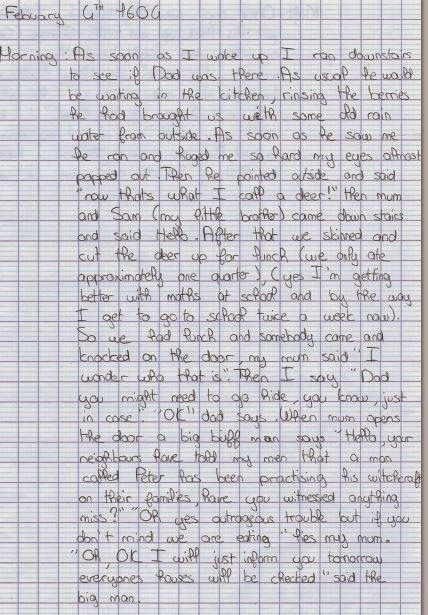
This month our 12-13 year old students have been working on a unit of work based on the book 'Witch Child' by Celia Rees. It tells the story of the world of Mary Newbury, whose grandmother is accused and murdered for being a witch. Her story is told in the style of a diary.


One of the tasks was to create a poster, warning people in 17th century England of witches. The students came up with some wonderful ideas and here are a few of their designs.


 Angus's poster.


Elena's poster.


Jake's poster.

For another lesson they had to write a diary entry, as if they were someone or knew someone who had been accused of witchcraft.

 Angus's diary entry.


Jake's diary entry.


Elena's diary entry.

Thursday, 8 January 2015

6 ways to read your way to a healthier 2015!


January is here again!
Once again we will all be looking to become better people. Be it slimmer, smoke-free, alcohol refraining, multi-lingual, kinder or less-stressed. The list goes on. For many, these admirable aims will fall by the way side within a few weeks. However, one area you can succeed in, and improve your life immeasurably is by making a list of literary resolutions. You may not have a slimmer waist line nor win the Nobel Peace Prize, but these are resolutions that you can keep. And they’re fun!
                                                            

Read More
For many, life seems to get in the way of a good book. However, they are a great way to unwind and escape the pressures of the day. Try to read at least 30 minutes a day. Why not switch off the TV or computer and grab a book (or tablet) before going to sleep? In addition, you might want to set yourself a goal to read a book a month, or two, or more? Why not draw up a list of books that you feel you should read? Or just ones that interest you?
Read New
Whilst buying a second hand book is a cheap way to stay well-stocked with reading material, it doesn’t help the author. They only receive payment once. Why not buy a new book for every three second-hand books you read.


Read Debut
Change can be a frightening thing. However, it can also reap rich rewards. Every now and then why not plunge into the sea of new writers out there. If you have a favourite writer, investigate who they like and recommend. Established writers often champion those new in print. Find out who they recommend.
Read Local
For many would-be book buyers the first thing they will do is type ‘Amazon’ on their keyboard. However, why not wander down to your local bookshop (or even find out where it is). Many local bookshops are fighting a losing battle at the moment to online retailers. Where you spend your money is a personal choice and deciding to help a local business, especially an independent  bookshop, can mean the difference between them staying afloat or disappearing to the stockroom in the sky.
Read Different
Even if you love sports autobiographies or gritty crime novels, why not break out into a different genre? If you have a subject that has always interested you but you’ve never got round to reading about it, do it this year! Or maybe something you’ve just heard about or read and want to know more. Go on, pick up that book and read it.


Read and Recommend
If you’ve read a great book, don’t keep it to yourself. Let friends and family know about it. Why not donate the books you’ve enjoyed reading to a charity and slip a note into each one saying how great it is? This way, the author’s work gets passed along and you’ve helped out a good cause. Plus you’ll have book space for all of your new purchases for 2015.

Finally remember that sometimes the fun things in life can get forgotten about in the mad rush of family life and work. Even if you only do one of the above, you will have a great 2015. 


This post was written by Andy Mackay ( KS3 & IGCSE Tutor at Blackhen Education).

Contact us at: sue@blackheneducation.com for one of our recommended reading lists for children.

www.blackheneducation.com 


Wednesday, 3 December 2014

Key Stage 3 - Gothic Literature


One of the units for our 12-13 year old students is 'Gothic'.

Most of our older students have heard of 'Dracula' and 'Frankenstein, but have not studied the texts or genre of Gothic literature in their French schools. They only know of the characters from films and comics.

In the unit of four lessons, they look at:

1) The Gothic genre
2) Research Dracula or Frankenstein
3) Design a book cover for a Gothic novel
4) Write an interview with a character from a Gothic novel

We believe it is important to have a mixture of written and creative tasks in the units for all of our students. Here are some of the wonderful book cover designs we received this year.


I am always impressed with the imaginative and creative designs they come up with!


 I love the 'foggy' atmosphere that this student has been able to achieve with her front cover for Dracula. I also like the choice of font for the description for the book.


This poster is brilliant! It was all hand drawn by Dan and is really quite creepy when you see it in the flesh!

Friday, 14 November 2014

World War One Poetry

My Favourite WW1 Poem


Most people will have studied some poetry from the First World War during their time at school. Many of these poems are read or printed each year in the run up to November 11th. Amongst the most ‘popular’ are the haunting and bitter ‘Dulce Et Decorum Est’, the poignant ‘In Flanders Fields’ and the idealistic but tragic ‘The Soldier’. All poems from this genre reveal some aspect of the horror from the trenches of France and Belgium.

My favourite poem from this period is one that doesn’t crop up too often. I learnt this whilst at school and it conveyed to me everything that I needed to know about the war. ‘The General’ by Siegfried Sassoon is one of the shortest poems about World War One. At 7 lines it is remarkably short to communicate the futility of the war. But it does just that.

It starts off in a terribly breezy, very British way with an old General wishing the passing troops ‘good morning’. Initially he comes across as a friendly guy, just one of the men. However, the darker side of the poem comes in when we learn that most of the troops he says hello to are dead. The poem then goes on to comment about the inadequacy of the army leadership. We then get to meet (briefly) two British Tommies, Harry and Jack; we have a personal insight of this meeting. They seem to epitomize the decency of the ordinary British soldier and his unquestioning nature. Harry’s response is simply that the old major is a happy soul. The poem then ends with the abrupt news that both of the soldiers have died due to the detached and ultimately useless general. 

Unlike the graphic nature of Owen’s ‘Dulce Et Decorum Est’ with a detailed account of watching a soldier die from a gas attack or the almost dreamy nature of Brooke’s ‘The Soldier’ mulling over how his death will some how be glorious in turning foreign soil English, ‘The General’ shows in a short regimented way the poorly thought out tactics of many commanders in the First World War and their terrible consequences. The contrast between the General’s pleasant demeanour and the outcome of the Battle of Arras, which resulted in the deaths of thousands pinpointed for me the gaping chasm in those that did the fighting and those that didn’t. Whilst the General comes across as a nice old buffer, his apparent detachment or complete incompetence with military tactics and what is actually happening at the front, is clearly conveyed. In 7 lines the reader can really believe the  rumours of Commanders sitting in grand country houses miles behind the front line sipping claret, whilst ordinary soldiers were perishing in the mud and bullets of the Western Front. All in all it is a deceptively simple yet terribly powerful poem.

The reason why I like this poem is exactly because it’s simple. The length makes it very accessible and as a child I actually memorised it. I like the image of the apparently good natured old General cheering his weary troops up with a sprightly ‘hello’. It makes us feel that all of the top brass aren’t so bad. I also liked the two Tommies, Harry and Jack. One could almost see them marching along through the French countryside to be met by this old military man. The way Harry ‘grunts’ to his mate that ‘E’s a cheery old card’ made me like the seemingly good natured soldiers. And then we learn in the last line that both of these men are to become victims of this General’s ‘plan of attack’. So the seemingly benign old boy has actually got them killed. A clear, simple snapshot of the brutal and often short life for a front-line soldier on the Western Front.


The General


“Good-morning, good-morning!” the General said
When we met him last week on our way to the line.
Now the soldiers he smiled at are most of 'em dead,
And we're cursing his staff for incompetent swine.
“He's a cheery old card,” grunted Harry to Jack
As they slogged up to Arras with rifle and pack.

But he did them both by his plan of attack.


This post was written by Andy Mackay, KS3 & IGCSE Co-Ordinator at Blackhen Education.


Wednesday, 4 June 2014

To Kill or not to Kill a Mockingbird?


In the last ten days two stories have loomed large in the world of Literature. One was the announcement that two titans from the world of 20th century Literature, namely ‘Of Mice and Men’ and ‘To Kill a Mockingbird’, were amongst a number of texts to be dropped from the English Literature syllabus of several exam boards in the UK. The other was the death of writer and Civil Rights campaigner, Maya Angelou. The two events were met with many column inches, both in the press and on the Net. However, the responses were very different. The former story garnered a general intake of breath and then an angry outcry from many. The latter produced an outpouring of sadness and a sense that one of America’s great voices in Literature, had passed.

The decision to drop a range of American literary texts was apparently at the behest of the current British Secretary of State for Education, Michael Gove. The head of the OCR examining board’s review committee Paul Dodd, said that Mr. Gove wished that schools in England should concentrate on British literature from now on. In addition, it was reported that he had a particular dislike for ‘Of Mice & Men’ and was concerned that so many British school children studied it (close to 90% according to recent figures). So is this the end for Lennie, George, Atticus and Boo?


Is there time to teach ‘additional texts?’


Mr. Gove has now hit back against his critics, claiming that he hasn’t requested they be dropped nor in fact hates Steinbeck’s book. What ever the real truth is, the new reading lists for the British exam boards of OCR, AQA and EDUQAS (formerly WJEC) do not list Steinbeck, Lee or in fact any American writers. The Secretary of State for Education has stated in an open letter to the British newspaper ‘The Telegraph’ that ‘schools are free to teach these texts in addition to the proscribed ones’. However, with time being a major factor for English teachers, it is highly unlikely that most schools will find neither the time nor the inclination to do so. Schools these days live or die by their exam results, so quite simply if children are not going to be examined on a text, they won’t study it. Results are the name of the game in the UK classroom of 2014.


                           Why should children study these books?

From my personal experience both ‘Of Mice and Men’ and ‘To Kill a Mockingbird’ pack a punch. In Steinbeck’s story, we see the bleak and at times brutal world of rural America during the Great Depression. Though a short text, with only six chapters, it manages to both tell an engaging tale but also to deal with a number of important themes. These range from the casual racism of the farm workers directed towards the long suffering black stable hand Crooks, to the fear that any of the men could lose their job if they incur the wrath of their boss or his arrogant, bully of a son.

Kids enjoy this story!

This text is taught in so many schools for good reason. It is quite simply a brilliant story that in my experience has never failed to interest and usually entrance, the students who are reading it. From the first pages where there is open mockery of the hapless and slow-witted Lennie, to the final page, where on more than one occasion, a student has burst in to tears at the powerful and dramatic dénouement. Kids enjoy this story! What’s more they care about the characters and the issues raised. As a teacher I can only echo the remarks of many in the press and on the Net last week, that regardless of ability this is a story that engages students. It may not be George Elliot’s ‘Middle March’ or Jane Austin’s ‘Pride and Prejudice’ (two favourites of Mr. Gove apparently), but for a 15 year old at an inner city school, this tale of poverty, violence and murder from 1930s America resonates much more for them.


Atticus, the single father and liberal lawyer is surely 
a great role model for today’s teenagers.


‘To Kill a Mockingbird’ is a similarly loved story. The tale of Scout and Jem and their inspirational father Atticus, in the southern town of Maycomb in the 1930s, operates on a very similar level to Steinbeck’s tale. An apparent slow-burning story that gradually builds to an exciting climax, has again drawn in nearly all that I have taught the text to. It has the obvious messages of fairness and justice, but also the message that following one’s beliefs is more important than being popular. Surely this is so important in an age of vacuous celebrity, where teenagers need to see that looking and sounding like everyone else is not necessary a good thing, particularly if what the ‘herd’ espouses is wrong. Atticus, the single father and liberal lawyer is surely a great role model for today’s teenagers. Here is a man who not only uses his brain to defend the innocent but who is also willing to put his life on the line (by spending the night before the trial outside the jail to protect the innocent Tom Robinson from a lynch mob). His strength comes not from being a muscle-bound, ex-special forces, tough guy with a gun, but a softly spoken man that believes in right and wrong.


Should Education be a politics free-zone?

So is it right that a politician can decide what book children can study and teachers can teach? At the moment we are in a situation where people are still arguing about what was actually said. Surely education needs to be free from political interference, be it actual or inferred. These two books, considered classics by many, should be judged first and foremost on their merits and not on the nationality of those that penned them. They were written in the English language, have engaged and educated generations of British school children and are in the opinion of this teacher, needed more today than ever.


So how do the alleged literary preferences of a British minister relate to the highly esteemed Maya Angelou? Well for one, the first part of her series of autobiographical books ‘I Know Why the Caged Bird Sings’ will also lose its current place on the English Literature list. Secondly, Maya Angelou once said that any book that gets a child reading and engaged is a good book. I for one wouldn’t disagree.

#IGCSE #English #ToKillaMockingBird 


This post has been written by Andy Mackay (IGCSE English tutor at Blackhen Education).

Details of our IGCSE English courses can be found on our website: www.blackheneducation.com